 EN
EN

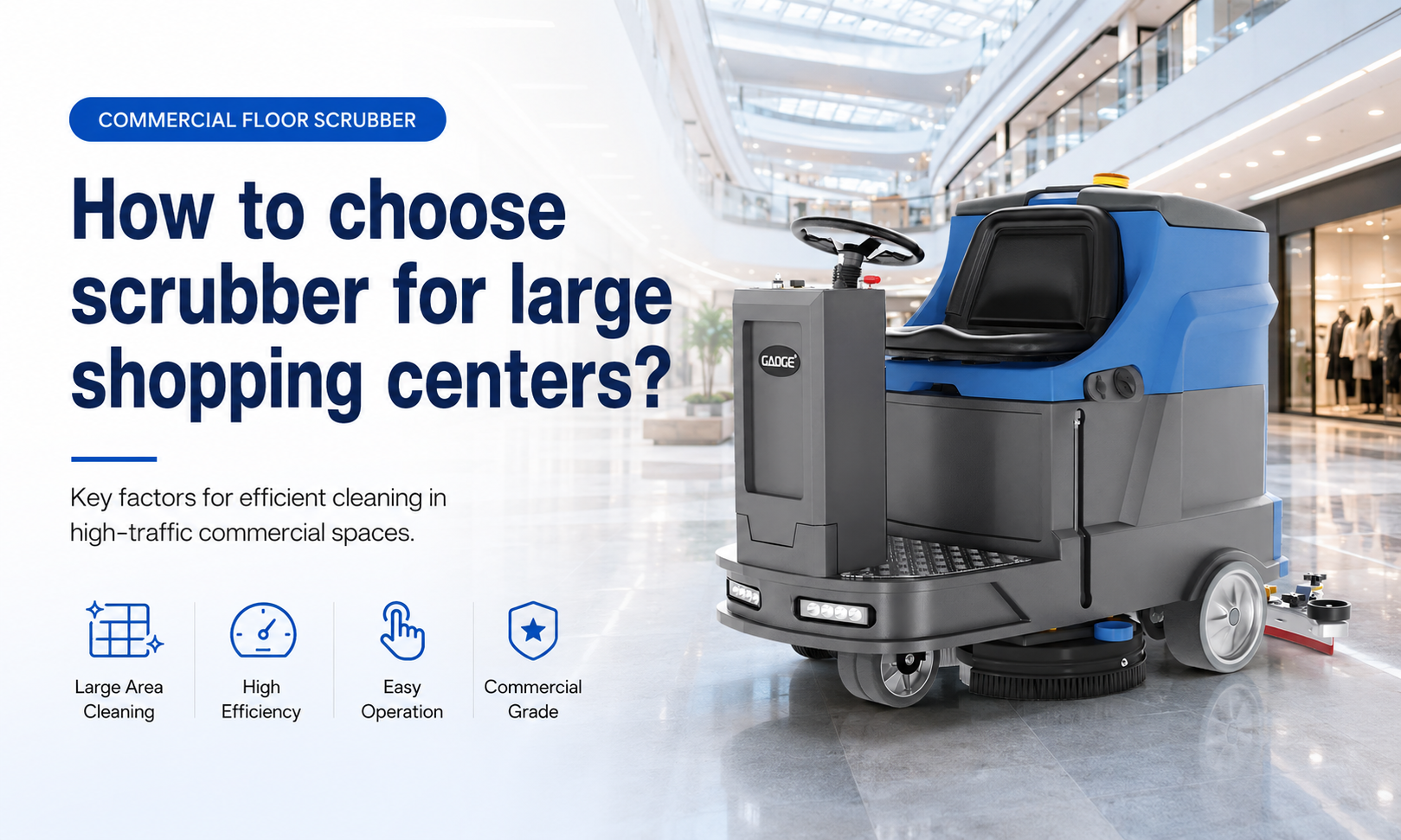
Understand the Unique Demands of Large-Scale Retail Environments
High foot traffic, food courts, and recirculated air create complex contamination profiles
Large shopping centers host thousands of visitors daily—each tracking in dirt, moisture, and biological debris. Food courts add grease, sugary spills, and persistent organic odors. Meanwhile, HVAC systems that recirculate up to 85% of indoor air spread fine particulates, VOCs, and microbial residues across vast floorplates. A commercial floor scrubber must therefore address not just surface grime but submicron contaminants—including PM2.5 from adjacent parking structures and bioaerosols generated by dense occupancy.
Why square footage alone is insufficient: volume, ceiling height, and occupancy patterns drive scrubber sizing
A 200,000 sq ft retail space with 30-foot ceilings holds six times the air volume—and airborne contaminant load—of a standard 10-foot retail floor. Weekend surges, lunch-hour food court congestion, and holiday sales events introduce rapid, localized spikes in particulate and VOC concentrations. Sizing solely by square footage ignores these dynamics. Effective specification requires aligning airflow capacity, filtration performance, and battery endurance with actual spatial volume and real-time occupancy behavior—not just floor area.
Size Your Commercial Floor Scrubber by Air Changes per Hour (ACH) and Space Volume
Sizing a commercial floor scrubber for large retail environments demands an air-centric approach—not just surface coverage. The critical metric is air changes per hour (ACH), which integrates ceiling height, occupancy density, and contaminant generation rates. For example, a mall corridor with 30-foot ceilings holds vastly more airborne pollutants than a low-ceilinged storefront; without sufficient air turnover, cleaning solutions, resuspended dust, and VOCs recirculate instead of being captured or diluted. ASHRAE 62.1-2022 sets a baseline of 4 ACH for retail spaces—but during peak periods like lunchtime or holiday weekends, 6–8 ACH is strongly recommended to sustain acceptable indoor air quality and prevent moisture retention, slip hazards, and odor buildup.
Step-by-step CFM calculation: (Cubic volume × Target ACH) ÷ 60 — with real-world mall examples
To translate ACH into actionable scrubber specifications, calculate required airflow in cubic feet per minute (CFM):
(Cubic volume × Target ACH) ÷ 60
Consider a 200 ft × 100 ft × 30 ft shopping center zone:
Volume = 600,000 ft³
At 6 ACH → (600,000 × 6) ÷ 60 = 60,000 CFM
While no floor scrubber moves this full volume independently, this figure determines how effectively it must complement the facility’s HVAC system—especially near the floor boundary layer where 70% of settled contaminants reside. A ride-on scrubber with a 36-inch cleaning path and high-efficiency blower helps maintain localized air turnover, preventing stagnant microzones. Integration—not standalone capacity—is the design imperative.
Select Filtration That Targets Retail-Specific Contaminants
Beyond MERV-13: Why HEPA + Activated Carbon Dual-Stage Filtration is Essential for PM2.5, VOCs, and Odors
MERV-13 filters capture many larger particles but fail against ultrafine PM2.5—common in retail settings due to vehicle exhaust infiltration—and offer negligible removal of gaseous pollutants. In contrast, true HEPA filtration (99.97% efficiency at 0.3 microns) targets respirable particulates, while activated carbon layers adsorb VOCs from food service, cleaning agents, and synthetic materials. Facility trials confirm dual-stage systems reduce VOCs by 83% and odor intensity by 91%, surpassing ASHRAE 189.1-2022 performance benchmarks. Post-deployment, facility managers report a 76% drop in occupant complaints related to air quality and lingering smells.
The Dwell Time Dilemma: How Airflow Rate Impacts VOC Removal Efficacy—and What to Prioritize in Scrubber Specs
VOC adsorption depends on sufficient dwell time—the duration air remains in contact with activated carbon media. Higher airflow reduces dwell time, sharply diminishing removal efficacy. Scrubbers delivering ≤1,500 CFM optimize contact time for chemical adsorption without sacrificing practical coverage. Key evaluation criteria include:
| Specification | Benefit | Trade-off |
|---|---|---|
| Airflow Rate ≤1,500 CFM | Enables >90% VOC reduction through adequate dwell time | May require more passes in very large zones |
| Variable Speed Blowers | Dynamically match airflow to contaminant load (e.g., lower speed in corridors, higher in food courts) | Adds complexity and cost |
| Particulate Sensors | Trigger automatic filter regeneration when PM spikes occur | Requires periodic calibration |
Dwell time under 0.5 seconds cuts VOC removal by 45%. Battery runtime cannot offset this deficit: real-world data shows VOC concentrations rebound within seven hours if dwell time is inadequate—posing measurable health risks in enclosed retail spaces.
Evaluate Operational Readiness: Containment, Mobility, and Facility Integration
Operational readiness reflects purpose-built engineering for retail’s most vulnerable points: cross-zone contamination, spatial constraints, and workflow fragmentation. Leading commercial floor scrubbers deploy dual-sealing containment—negative-pressure housings paired with HEPA-certified exhaust ports—to enforce downward airflow. This prevents redispersion of food court aerosols, cleaning solution mists, or pathogen-laden dust between tenant zones—a critical safeguard where HVAC recirculation reaches 85%.
Battery Runtime, Maneuverability in Narrow Corridors, and Compatibility With Existing Maintenance Workflows
- Autonomy thresholds: Minimum 5.5 peak-hour battery runtime ensures uninterrupted cleaning across closing shifts—covering up to 28,000 m² without mid-cycle recharging.
- Spatial constraints: Units must pivot fully within 70 cm clearance (standard stock hallway width) while sustaining full brush downforce and suction integrity.
- Integration metrics: Silent-mode operation must sync precisely with warehouse management system (WMS) cleaning schedules, and charging hardware must interoperate with centralized docks already deployed across major retail chains—avoiding $740,000 in annual retrofit costs, per Ponemon Institute’s 2023 infrastructure benchmarking study.
FAQ Section
What are the key factors to consider when choosing a commercial floor scrubber for retail spaces?
Key factors include air changes per hour (ACH), cubic space volume, filtration efficiency (e.g., HEPA + activated carbon), battery runtime, maneuverability, and operational integration with existing systems.
Why is ACH important for floor scrubber specifications?
ACH determines how effectively contaminants are captured or diluted in a given space. Larger zones with high ceilings require higher ACH to maintain healthy air quality.
What contaminants are common in large retail environments?
Common contaminants include PM2.5 from vehicle exhaust, VOCs from food courts and cleaning agents, microbial residues, and fine particulates spread by HVAC systems.
Why is filtration performance critical for commercial floor scrubbers?
Filtration systems like HEPA and activated carbon effectively capture ultrafine particulates, VOCs, and odors, ensuring clean and breathable indoor air in retail spaces with heavy foot traffic.
How does operational readiness impact scrubber performance?
Operational readiness ensures the unit can handle spatial constraints, cross-zone contamination risks, and maintenance workflow integration—critical for uninterrupted and efficient cleaning.
Table of Contents
- Understand the Unique Demands of Large-Scale Retail Environments
- Size Your Commercial Floor Scrubber by Air Changes per Hour (ACH) and Space Volume
- Select Filtration That Targets Retail-Specific Contaminants
- Evaluate Operational Readiness: Containment, Mobility, and Facility Integration
-
FAQ Section
- What are the key factors to consider when choosing a commercial floor scrubber for retail spaces?
- Why is ACH important for floor scrubber specifications?
- What contaminants are common in large retail environments?
- Why is filtration performance critical for commercial floor scrubbers?
- How does operational readiness impact scrubber performance?
