 EN
EN

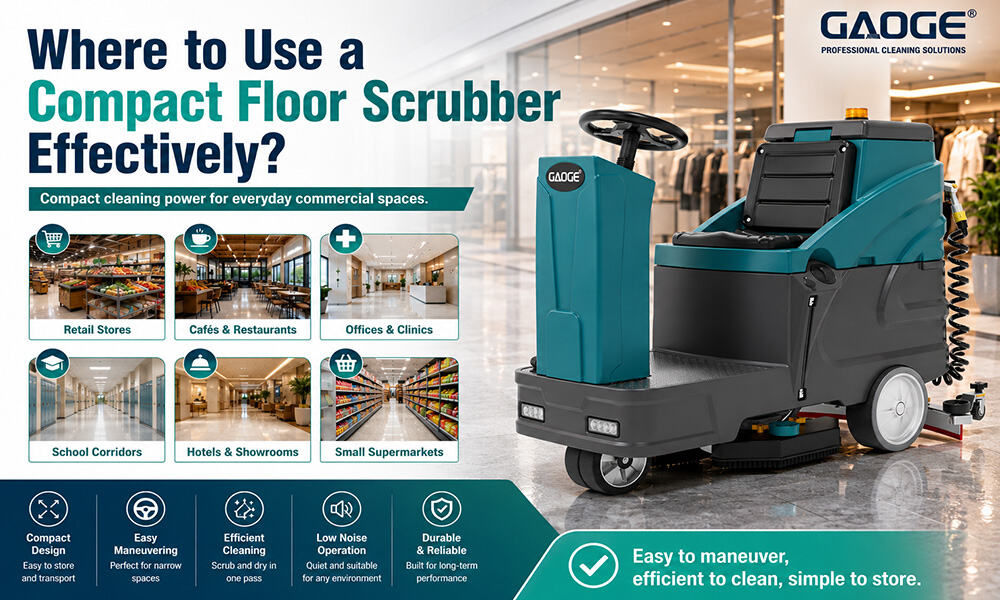
Compact Floor Scrubber Use Cases in Space-Constrained Environments
Maneuvering Through Tight Aisles, Elevators, and Doorways
In facilities where every inch counts, a compact floor scrubber becomes a critical tool. Its narrow frame—often under 24 inches wide—enables seamless navigation through tight aisles, standard doorways, and elevator cabs without repositioning. Unlike full-size riders, these machines feature a three-wheel or tight-turning rear steering system that supports 360-degree pivots around desks, shelving, and checkout counters. Operators can clean under low-hanging racks or between closely spaced tables in cafeterias and retail stockrooms, while the reduced footprint minimizes wall scuffing and fixture damage. Many models include a side brush for edge and corner cleaning—key accumulation zones for dirt and debris. For multi-floor buildings, light weight (typically under 300 lbs) allows staff to lift units into service elevators or carry them up short stair flights. This agility directly improves efficiency: a 2023 facilities study found that using a compact scrubber in a 5,000-sq-ft, maze-like office reduced total cleaning time by 40% compared to manual mopping—delivering consistent hygiene in high-traffic bottlenecks like hospital corridors and hotel lobbies.
Meeting Hygienic Zoning Requirements in Segmented Facilities
Many modern buildings—including long-term care homes, food processing plants, and research labs—enforce strict hygienic zoning to prevent cross-contamination. Compact floor scrubbers support these protocols by enabling zone-specific cleaning with minimal equipment transfer. Operators can move the machine between clean, transition, and dirty zones and adjust water flow or chemical dilution on the fly. In a hospital’s sterile prep area, for instance, the unit can run with a dedicated microfiber pad and hospital-grade disinfectant; when moved to a patient room, the pad is swapped per infection control policy. Its small size allows passage through air-lock doors and decontamination chambers inaccessible to larger scrubbers. Critically, some models feature fully isolated solution and recovery tanks—preventing contaminated water from recirculating into the scrubbing head—a requirement aligned with HACCP and Joint Commission standards. Because compact units fit inside zone-specific janitorial closets, they reduce the risk of accidental inter-zone use. One facility reported a 30% reduction in zone-cleaning time after replacing manual mopping with a compact scrubber—proving compliance and efficiency need not compete.
Facility-Specific Applications for Compact Floor Scrubbers
Retail: Checkout Areas, Fitting Rooms, and Narrow Aisles
Compact floor scrubbers excel in retail environments defined by spatial constraints and customer sensitivity. Checkout lanes—crowded with queue barriers, POS systems, and shopping carts—demand precise maneuverability; compact units navigate tight turns without disrupting shoppers or requiring lane closures. Fitting rooms benefit from discreet, low-profile cleaning during operational hours, maintaining hygiene without occupying valuable floor space. Boutique stores, pharmacies, and pop-up shops with narrow aisles (≤24 inches) rely on slim scrubbers to clean thoroughly between displays and fixtures. Retail facility managers report up to a 30% reduction in cleaning time for high-traffic zones versus traditional methods, supported by quiet operation (≤65 dB), which preserves the customer experience.
Healthcare: Patient Rooms, Labs, and Sterile Prep Zones
In healthcare settings, compact scrubbers meet stringent infection control demands without compromising mobility. Their ability to clean tightly around medical beds, IV poles, and diagnostic equipment ensures thorough coverage in confined patient rooms—while enclosed solution tanks prevent cross-contamination between zones, aligning with CDC floor-care guidance. Laboratories benefit from chemical-resistant construction when cleaning near sensitive instrumentation. For sterile prep zones, select models offer certified HEPA filtration, capturing 99.97% of airborne particulates ≥0.3 microns during operation—an essential safeguard in environments where healthcare-associated infections cost U.S. facilities $28.4 billion annually (CDC, 2023). The targeted, repeatable cleaning delivered by compact scrubbers provides measurable risk mitigation in clinical spaces where square footage and workflow efficiency are non-negotiable.
When a Compact Floor Scrubber Is the Optimal Cleaning Solution
Small Facilities (<10,000 Sq Ft) with High Obstacle Density
Compact floor scrubbers are especially effective in commercial spaces under 10,000 sq ft where obstacle density—not just square footage—dictates cleaning feasibility. Facilities packed with display units, production machinery, or fixed customer seating create navigation challenges that larger machines cannot overcome efficiently. The compact scrubber’s slim profile and tight turning radius allow operators to clean around permanent fixtures and temporary obstacles—like event staging or seasonal displays—without halting operations. This agility translates to faster, more consistent cleaning cycles across boutique hotel corridors, café floors, and retail backrooms, making compact scrubbers indispensable for maintaining hygiene standards where bulkier equipment would disrupt daily workflows.
Frequent Spot-Cleaning Needs vs. Full-Area Coverage
When rapid response to spills and localized soiling takes priority over scheduled deep cleaning, compact scrubbers deliver unmatched performance. Their quick deployment makes them ideal for:
- Food service areas requiring immediate grease and organic spill containment
- Entryways needing continuous dirt and moisture removal
- High-traffic zones where spot-cleaning preserves appearance between full cleans
Unlike larger machines optimized for broad-area coverage, compact scrubbers provide surgical precision—using less water and chemical per pass—reducing both operational costs and environmental impact. This targeted capability is especially valuable in facilities that prioritize responsive, on-demand maintenance over exhaustive daily scrubbing cycles.
Surface Compatibility and Floor Condition Guidelines
Before deploying a compact floor scrubber, assess floor material and condition. Most sealed hard surfaces—including ceramic tile, vinyl composition tile, polished concrete, and sealed natural stone—are compatible with automated scrubbing. Unsealed wood, linoleum, or high-gloss coatings may require alternative cleaning methods to avoid swelling, discoloration, or finish degradation. Inspect floors for cracks, loose tiles, or uneven joints that could cause water infiltration or machine instability. Slip-resistant flooring meeting dynamic coefficient of friction (DCOF) standards is recommended to maintain traction during scrubbing. In healthcare and food preparation areas, floors must be impervious to moisture and free of harborage points such as spalling, delamination, or porous grout lines. A brief pre-cleaning walkthrough helps confirm surface integrity and ensures safe, effective operation.
FAQ
What are the main advantages of using compact floor scrubbers over manual cleaning?
Compact floor scrubbers improve efficiency by reducing cleaning time, provide consistent hygiene, and minimize the risk of damage to walls, fixtures, or floor surfaces. They are especially effective in tight or obstacle-dense environments.
In what types of facilities are compact floor scrubbers most commonly used?
They are most commonly used in healthcare facilities, retail environments, segmented facilities with hygienic zoning, and any space where obstacle density requires precision cleaning, like boutique stores or small offices.
Can compact floor scrubbers meet hygienic zoning requirements?
Yes, compact floor scrubbers can support strict hygienic zoning protocols by allowing zone-specific cleaning and featuring isolated solution and recovery tanks to prevent cross-contamination.
What surfaces are compatible with compact floor scrubbers?
Compact floor scrubbers are compatible with most sealed hard surfaces, such as ceramic tile, vinyl composition tile, polished concrete, and sealed natural stone. Unsealed or high-gloss floors may require alternative cleaning methods.
Why are compact scrubbers better for spot-cleaning?
Compact scrubbers are ideal for spot-cleaning because they deploy quickly and use less water and chemicals per pass, making them efficient for addressing spills and localized dirt without disrupting regular workflows.
Table of Contents
- Compact Floor Scrubber Use Cases in Space-Constrained Environments
- Facility-Specific Applications for Compact Floor Scrubbers
- When a Compact Floor Scrubber Is the Optimal Cleaning Solution
- Surface Compatibility and Floor Condition Guidelines
-
FAQ
- What are the main advantages of using compact floor scrubbers over manual cleaning?
- In what types of facilities are compact floor scrubbers most commonly used?
- Can compact floor scrubbers meet hygienic zoning requirements?
- What surfaces are compatible with compact floor scrubbers?
- Why are compact scrubbers better for spot-cleaning?
