 EN
EN

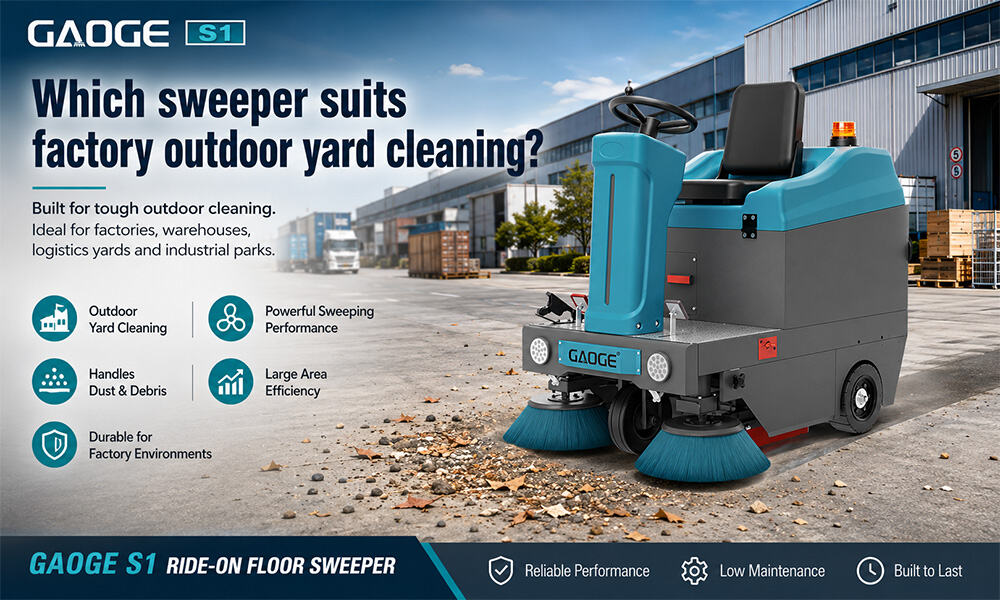
Key Selection Criteria for Industrial Floor Sweepers in Outdoor Yard Environments
Matching Debris Type, Area Size, and Dust Control Needs to Floor Sweeper Capabilities
Choosing the right industrial floor sweeper starts with aligning its capabilities to your outdoor yard’s operational realities. Total cleaning area directly influences machine format: walk-behind sweepers are optimal for zones under 15,000 square feet—especially where narrow aisles or congestion limit maneuverability—while ride-on models deliver superior speed, operator comfort, and efficiency across larger, open spaces.
Debris composition further narrows selection. Mechanical broom sweepers excel at heavy, abrasive materials like gravel, asphalt millings, or wood chips, thanks to their simple, durable design and high-torque brush systems. For fine dust, dirt, pollen, or light leaf litter—common in loading docks or material staging areas—regenerative air sweepers offer superior capture without surface abrasion or airborne dispersion. Their closed-loop airflow system lifts and contains particles within a sealed filtration path, supporting both performance and environmental stewardship.
Dust control is non-negotiable outdoors—not just for air quality compliance (e.g., OSHA’s respirable crystalline silica standard and EPA ambient air guidelines), but also for worker safety and equipment longevity. Modern outdoor-capable sweepers increasingly integrate waterless dust suppression, using multi-stage filtration (often including cyclonic pre-separation and HEPA-grade final filters) to trap sub-micron particles without moisture. This eliminates slip hazards, freeze risks, and post-cleaning drying delays—critical advantages in variable climates and mixed-use yards.
| Floor Sweeper Feature | Best Suited For | Key Consideration |
|---|---|---|
| Walk-Behind Sweeper | Areas under 15,000 sq ft | Efficient for narrow aisles and congested spaces |
| Ride-On Sweeper | Continuous, open areas over 15,000 sq ft | Significantly higher cleaning speed and operator comfort |
| Mechanical Broom | Heavy debris (e.g., millings, sand, gravel) | Simple, durable, and reliable for tough materials |
| Regenerative Air | Fine debris (e.g., dust, dirt, leaves) | Best for multi-purpose cleaning and eco-friendly operation |
Durability and Terrain Handling: Navigating Rough Surfaces, Curbs, and Slopes
Outdoor factory yards rarely feature smooth, level pavement. Drainage grates, cracked concrete, raised curbs, and graded slopes demand more than basic mobility—they require purpose-built terrain resilience. Look for sweepers with heavy-gauge steel frames, reinforced axle housings, and large-diameter pneumatic tires designed to absorb impact and maintain traction over uneven surfaces.
Ground clearance and side brush articulation are equally critical: units should clear common curb heights (typically 4–6 inches) while positioning side brushes close enough to walls, fences, or pallet racking to eliminate edge buildup—without risking brush damage or frame scraping. On inclines, stability depends on low center of gravity, responsive braking, and sufficient motor torque to ascend grades up to 15% without wheel slip or loss of suction/broom pressure. These features aren’t just convenience upgrades—they directly reduce unplanned maintenance, extend service intervals, and sustain consistent cleaning performance across shifting site conditions.
Ride-On Floor Sweeper Power Options and Dust Suppression for Factory Yards
Selecting the right power source and dust control method for a ride-on floor sweeper is critical for maintaining productivity, regulatory compliance, and long-term cost efficiency in large outdoor factory yards.
Diesel, Propane, and Battery-Powered Floor Sweepers Compared
Diesel-powered sweepers remain the benchmark for demanding outdoor applications—delivering high torque, extended runtime (often 8–10+ hours per tank), and proven reliability on rough terrain and steep slopes. They’re especially suited for facilities with heavy debris loads and long shifts, though emissions must be managed per local regulations and facility sustainability goals.
Propane (LPG) models offer a balanced alternative: cleaner combustion than diesel, consistent cold-weather performance, and lower NOx and particulate output—making them a strong fit for yards adjacent to sensitive areas or subject to tightening air quality ordinances. Like diesel units, they typically use larger displacement engines to sustain power under load.
Battery-electric sweepers provide zero tailpipe emissions, quiet operation, and reduced maintenance (no oil changes, exhaust systems, or fuel filters). However, real-world uptime depends on robust charging infrastructure and strategic battery management—particularly in multi-shift operations. While newer lithium-ion platforms now support opportunity charging and 8-hour shifts, facilities must evaluate daily cleaning duration, shift overlap, and available electrical capacity before committing. Ultimately, the choice hinges on fuel logistics, emission requirements, noise sensitivity, and total cost of ownership—not just upfront price.
Waterless Dust Control Systems in Outdoor Floor Sweepers
Waterless dust suppression has become the industry standard for outdoor industrial sweepers—especially where freezing temperatures, water scarcity, or strict runoff controls apply. These systems combine high-efficiency vacuum suction with engineered filtration: cyclonic separators remove coarse particles upfront, while secondary filters (often rated to ISO Class 15–17 or equivalent to HEPA efficiency) capture respirable dust down to 0.3 microns.
This approach eliminates the safety hazards and operational friction of wet suppression—no slippery surfaces, no frozen hoses or tanks, no post-cleaning drying time. It also simplifies waste handling: dry, compacted debris flows cleanly into the hopper and can be disposed of or recycled without dewatering steps. For yards handling cement, foundry sand, or metal grinding dust, waterless systems prevent slurry formation and corrosion while helping meet OSHA’s silica exposure limits and EPA National Ambient Air Quality Standards (NAAQS).
Performance Optimization: Cleaning Width, Hopper Capacity, and Uptime for Large-Scale Yards
In large-scale outdoor yards, productivity isn’t just about raw speed—it’s about sustained, interruption-free coverage. Three interdependent metrics define real-world effectiveness: cleaning width, hopper capacity, and operational uptime.
A wider cleaning path—typically 40 to 60 inches—directly increases square footage cleaned per hour, reducing pass count and operator fatigue. But width alone is insufficient without adequate hopper volume: for continuous operation across expansive yards, a minimum 400-liter hopper significantly cuts downtime from frequent dumping. Larger capacities (600–1,000 L) are advisable for high-debris environments or single-shift operations aiming to minimize interruptions.
Uptime, however, is the linchpin. It depends less on peak specs and more on design integrity: easy-access service points (oil drains, filter housings, brush adjustments), component durability (brush wear indicators, sealed bearings), and power system reliability (fuel gauge accuracy, battery state-of-charge monitoring). When cleaning width, hopper size, and uptime converge, the result is predictable, scalable cleaning performance—lowering labor costs per square foot, preventing backlog accumulation, and reinforcing yard readiness for logistics, safety audits, and operational continuity.
FAQs
What are the key factors to consider when selecting an industrial floor sweeper for outdoor use?
You should consider factors such as debris type, area size, dust control needs, terrain durability, and power source. These aspects will ensure the sweeper aligns with your operational demands and environmental requirements.
Are ride-on sweepers better than walk-behind sweepers?
Ride-on sweepers are better for large, open areas (over 15,000 sq ft) due to their speed and efficiency. Walk-behind sweepers are optimal for smaller, congested or narrow spaces under 15,000 sq ft.
What are the differences between mechanical broom and regenerative air sweepers?
Mechanical broom sweepers are ideal for heavy, abrasive debris like gravel and sand, while regenerative air sweepers are better for fine, lightweight debris such as dust and leaves due to their superior dust containment systems.
Why is waterless dust suppression important in outdoor sweepers?
Waterless systems avoid safety hazards like slippery surfaces and freezing issues while maintaining efficient dust control. They are cost-effective and suitable for maintaining regulatory compliance in various climates.
Which power option is best for a ride-on sweeper?
The best power option depends on your needs. Diesel sweepers are powerful and durable, propane sweepers have cleaner emissions, and battery-electric options offer quiet, emission-free operation with lower maintenance.
