 EN
EN

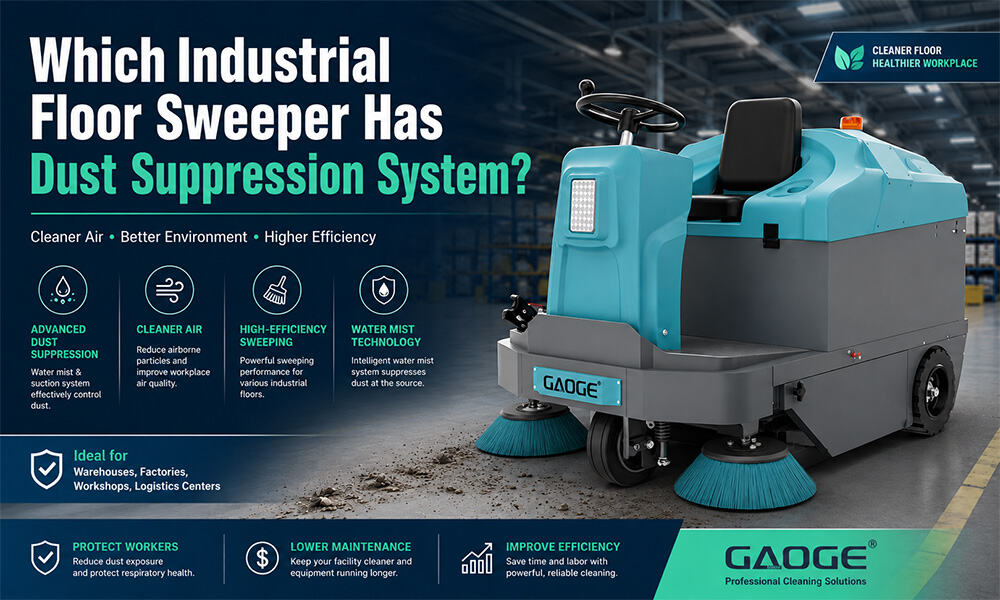
How Industrial Floor Sweepers Achieve Effective Dust Suppression
Core mechanisms: Sealed suction paths, multi-stage filtration, and hopper containment
Effective industrial floor sweepers prevent dust from becoming airborne through three integrated, engineered mechanisms. A fully sealed suction path creates controlled airflow that captures debris at the brush zone and directs it into the machine without leakage—eliminating the primary source of fugitive dust. Multi-stage filtration follows: a primary filter traps coarse particles, while a secondary HEPA or baghouse filter captures fine, respirable dust down to 0.3 microns. Finally, the hopper provides secure, leak-proof containment—using compression gaskets, magnetic latches, or continuous-fill designs—to seal collected material away from the work environment. This closed-loop system ensures dust remains captured from pickup through disposal, reducing airborne particulate concentrations by up to 95% compared to non-suppressing sweepers.
Dust suppression vs. dust control vs. filtration — clarifying terminology for facility decision-makers
These terms describe distinct but interdependent functions in dust management. Dust suppression actively prevents dust generation at the source—using sealed brush enclosures, wet misting, or foam application before debris is disturbed. Dust control manages already-airborne particles via air movers, barriers, or ambient filtration—not part of the sweeper’s core function. Filtration, in contrast, refers specifically to particle removal within the sweeper’s air stream, enabling clean exhaust and protecting internal components. For facility managers, understanding this hierarchy is critical: OSHA PEL compliance depends first on suppression (stopping dust release), second on filtration (capturing what enters the machine), and only third on external control measures. Selecting equipment based on suppression capability—not just filtration rating—ensures regulatory alignment and long-term worker safety.
Top Industrial Floor Sweepers with Built-in Dust Suppression
Advance SW8000: Dual-stage HEPA+ baghouse filtration for heavy-duty industrial floor sweeper applications
The Advance SW8000 delivers proven dust suppression in demanding environments like metal fabrication, concrete production, and foundries. Its sealed suction path eliminates bypass leakage, while its dual-stage HEPA+ baghouse filtration captures 99.97% of particles ≥0.3 microns—including respirable crystalline silica. The reinforced, gasketed hopper maintains integrity during transport and dumping. Independent air quality testing in metalworking facilities showed post-cleaning PM2.5 levels consistently below 0.5 mg/m³—well under OSHA’s 5 mg/m³ PEL for general dust and aligned with NIOSH’s stricter 0.025 mg/m³ recommendation for silica.
Factory Cat 34: Lifetime-sealed baghouse design and leak-proof hopper integration
The Factory Cat 34 features a maintenance-free, lifetime-sealed baghouse—eliminating filter changes and associated exposure risk during service. Its hopper uses dual compression gaskets and magnetic latches to achieve zero-leak performance verified under ASTM F2100-22 containment testing. Designed for high-fidelity containment of ultrafine powders, it’s widely deployed in food processing (flour, sugar), pharmaceutical manufacturing, and battery material handling. Facilities report no measurable dust escape during hopper emptying—even after 12+ hours of continuous operation—making it ideal where cross-contamination or explosion risk (per NFPA 652) is a concern.
Viper ROS1300: Wet misting + mechanical brushing for ultrafine dust suppression in high-risk industrial floor sweeper environments
The Viper ROS1300 uniquely combines low-volume, high-precision wet misting with aggressive mechanical brushing to suppress dust before it becomes airborne. Its integrated water tank feeds adjustable nozzles positioned directly at the brush head, applying moisture only where needed—minimizing slip risk and avoiding oversaturation. Certified to OSHA’s 2023 respirable crystalline silica standard (29 CFR 1926.1153), it reduces silica aerosol generation by >90% in sandblasting prep areas and quarry operations. Unlike conventional wet sweepers, its closed-loop water recovery system prevents wastewater discharge and meets EPA stormwater compliance requirements.
Why Dust Suppression Is Non-Negotiable for Health, Safety, and Regulatory Compliance
Reducing respirable dust exposure, OSHA PEL compliance, and mitigating slip/trip hazards
Respirable dust—particularly silica, beryllium, and metal fumes—is a leading cause of occupational lung disease. Chronic exposure contributes to silicosis, COPD, and lung cancer, with NIOSH estimating over 2.3 million U.S. workers face hazardous silica exposure daily. An industrial floor sweeper with verified dust suppression directly reduces airborne particulate concentrations, helping facilities meet OSHA’s PEL of 50 µg/m³ for respirable crystalline silica—and avoid citations averaging $15,000 per violation. Equally critical, dry dust accumulation degrades floor traction: even a 0.1-mm layer of fine powder can reduce coefficient of friction by 40%, significantly increasing slip/trip incident rates. By controlling dust at the source—through sealed paths, true HEPA-grade filtration, and leak-proof hoppers—modern sweepers deliver dual protection: safeguarding respiratory health and preventing falls. This convergence of health, safety, and compliance makes robust dust suppression not an option, but a foundational requirement for responsible facility operations.
Selecting the Right Industrial Floor Sweeper Dust Suppression System for Your Facility
Choosing the right system requires matching engineering capabilities to your operational reality—not just marketing claims. Begin with workspace analysis: narrow aisles (<10 ft) demand compact, zero-turn sweepers with front-mounted brushes and sealed side skirts; open warehouses (>100,000 sq ft) benefit from high-capacity hoppers (≥100 gal) and extended runtime batteries or LPG systems. Next, evaluate debris profile: silica- or graphite-heavy environments require certified HEPA filtration (per ISO 29463-1) and wet suppression; combustible dust settings must comply with NFPA 652 ignition-source controls—including static-dissipative brushes and grounded chassis. Third, assess usage intensity: machines operating 16+ hours/day need commercial-grade motors (IP55-rated), ceramic-coated bearings, and brush wear indicators—not consumer-grade components. Finally, confirm regulatory alignment: verify third-party test reports showing containment performance (e.g., ASTM F2100-22), OSHA 1910.94 compliance documentation, and NFPA 652 hazard classification support. Power source decisions should weigh total cost of ownership—not just upfront price: electric models cut emissions and noise but require 220V charging infrastructure; propane variants offer outdoor flexibility but introduce ventilation and fuel storage considerations. Aligning these factors ensures your industrial floor sweeper delivers measurable, auditable dust suppression—not just nominal filtration claims.
FAQ
What is the difference between dust suppression and dust control?
Dust suppression works to prevent dust from becoming airborne by addressing it at the source, while dust control manages already-airborne dust particles using external measures like barriers or ventilation.
Why is dust suppression important for industrial facilities?
Dust suppression helps reduce respirable dust exposure, ensuring OSHA compliance, promoting worker health and safety, and mitigating hazards such as slips and trips caused by dust accumulation.
What factors should facility managers consider when selecting an industrial floor sweeper?
Key considerations include workspace size, debris type, usage intensity, and regulatory requirements such as OSHA and NFPA compliance. Understanding these factors ensures optimal system performance and safety.
How does HEPA filtration improve dust suppression?
HEPA filtration captures fine particles as small as 0.3 microns, preventing them from re-entering the air and providing clean exhaust, which is essential for meeting health and safety standards.
Table of Contents
- How Industrial Floor Sweepers Achieve Effective Dust Suppression
-
Top Industrial Floor Sweepers with Built-in Dust Suppression
- Advance SW8000: Dual-stage HEPA+ baghouse filtration for heavy-duty industrial floor sweeper applications
- Factory Cat 34: Lifetime-sealed baghouse design and leak-proof hopper integration
- Viper ROS1300: Wet misting + mechanical brushing for ultrafine dust suppression in high-risk industrial floor sweeper environments
- Why Dust Suppression Is Non-Negotiable for Health, Safety, and Regulatory Compliance
- Selecting the Right Industrial Floor Sweeper Dust Suppression System for Your Facility
- FAQ
