A floor scrubber is designed to scrub the floor and recover dirty water in the same cleaning pass. If the machine starts leaving water streaks, wet patches, or a visible trail behind the squeegee, it does not necessarily mean that the vacuum motor has failed.
In practical use, poor water recovery is often caused by simpler issues such as worn squeegee blades, incorrect squeegee adjustment, a blocked suction hose, air leakage around the recovery tank, or debris trapped underneath the blade.
The most effective way to troubleshoot the problem is to check the water recovery system step by step, starting with the easiest components before moving on to the electrical system and vacuum motor.
The squeegee blades are one of the most important parts of the dirty-water recovery system.
As the machine moves forward, the blades maintain contact with the floor and guide wastewater toward the suction opening. If the rubber becomes worn, deformed, cracked, or hardened, it may no longer maintain continuous contact with the floor.
Water can then pass through the gaps and remain behind the machine.
Two factors are particularly common.
Long-term use
Squeegee blades are consumable parts. Continuous contact with the floor gradually wears down the working edge.
Abrasive floor surfaces
Blade life also depends heavily on the floor being cleaned.
A machine used mainly on smooth commercial flooring may experience relatively slow wear, while frequent operation on rough concrete or other abrasive industrial surfaces can consume the blades much faster.
For this reason, squeegee replacement should not be based only on operating hours. The actual condition of the rubber is more important.
A visibly wavy or deformed blade may no longer maintain consistent floor contact, allowing dirty water to escape beneath the squeegee.
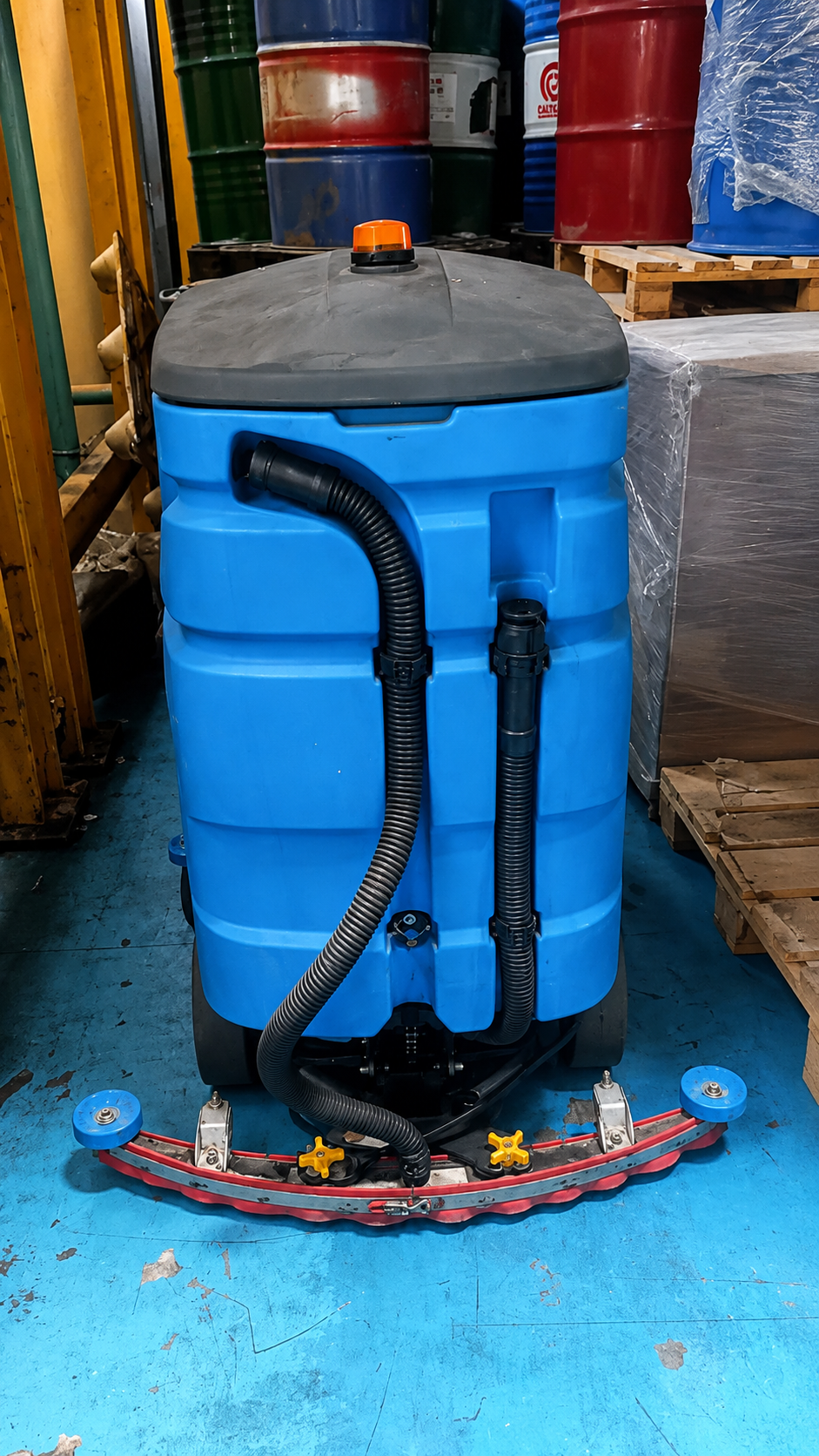
Used floor scrubber squeegee blade showing visible deformation after extended operation.
When inspecting the blade, check for:
If the blade is already badly worn or deformed, timely replacement is usually the most practical solution.
Even when the squeegee blades are still in good condition, the machine may leave water behind if the entire squeegee assembly is not positioned correctly.
For effective water recovery, the blades should maintain stable and even contact across the floor.
If one side of the squeegee is positioned too high or the angle is incorrect, pressure on the rubber becomes uneven. The machine may dry one side properly while leaving a visible water line on the other.
Many floor scrubbers, including several GAOGE models, use a conventional manual adjustment structure.
With this type of design, the operator adjusts the squeegee position manually and observes how the blade contacts the floor during operation.
If the contact is uneven, further fine adjustment may be required until the squeegee sits correctly across its full width.
If a machine begins leaving noticeably more water on one side than the other, checking squeegee position should therefore be one of the first troubleshooting steps.
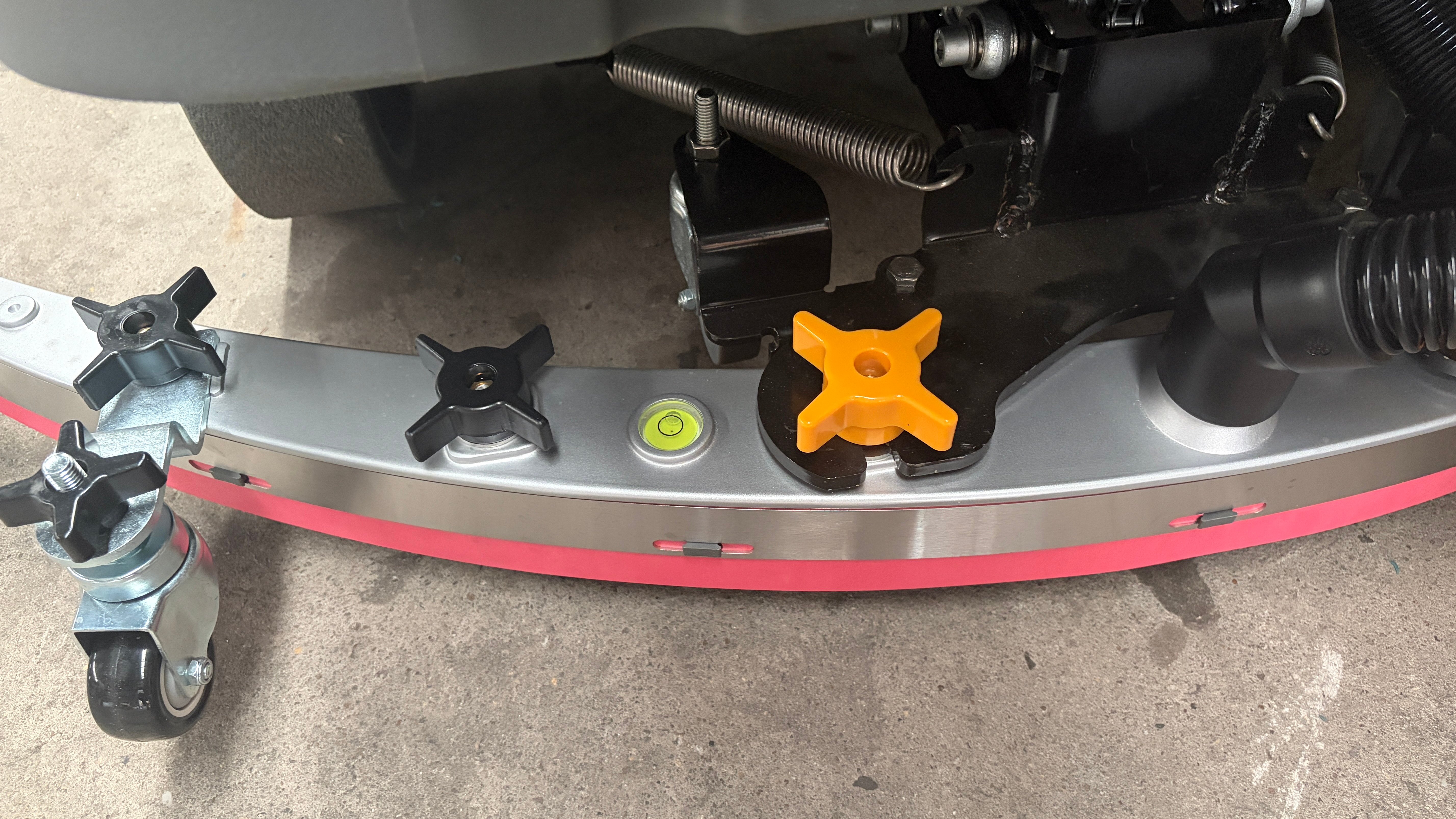
GAOGE X Series floor scrubbers use a different squeegee structure with an integrated bubble level.
The bubble level provides an additional visual reference when checking squeegee position.
Instead of relying only on visual judgment and repeated operating tests, the operator can observe the bubble position to help determine whether the squeegee assembly is level.
This makes routine inspection and adjustment more intuitive, particularly when troubleshooting uneven water recovery.
The integrated bubble level is a feature of GAOGE X Series floor scrubbers and is not used on all GAOGE models.
Regardless of which adjustment structure is used, the objective is the same: the squeegee blades must maintain stable and even contact with the floor.
Sometimes a floor scrubber works normally and then suddenly begins leaving one continuous water line.
Before inspecting the vacuum motor, stop the machine and check underneath the squeegee.
Hair, thread, small pieces of plastic, mud, packaging fragments, or other particles may become trapped between the rubber blade and the floor.
Even a small object can create a gap.
Dirty water then passes through this gap instead of being guided toward the suction opening.
If the machine suddenly begins leaving a narrow streak, removing debris from underneath the blade may restore normal drying immediately.
This is also why cleaning the squeegee after each working shift is a useful maintenance habit.
The suction hose carries dirty water from the squeegee assembly to the recovery tank.
During cleaning, however, the machine may pick up more than water.
Hair, fibers, small stones, sludge, packaging debris, and other contaminants can enter the recovery system. Over time, these materials may accumulate inside the hose and restrict airflow.
The hose does not need to be completely blocked before water recovery is affected.
A partial blockage may cause:
In many cases, the problem can be solved by cleaning the hose and removing accumulated debris.
Checking the suction hose is therefore a practical step before considering replacement of major components.
The vacuum system depends on the recovery tank being properly sealed.
If outside air enters through a gap around the tank lid, vacuum pressure can decrease even while the vacuum motor itself is operating normally.
The sealing strip around the recovery tank lid may gradually harden, crack, deform, or lose elasticity after long-term use.
Once it can no longer seal the tank correctly, air leakage may reduce suction performance.
If the sealing strip is visibly damaged or permanently deformed, replacement is recommended.
A sealing problem does not always mean that the sealing strip needs replacement.
Hair, oil, dirt, and other contaminants may become trapped between the recovery tank lid and the sealing strip when wastewater is emptied.
The seal itself may also move out of position or become twisted.
Clean the sealing surface and make sure the strip sits evenly in its groove before closing the tank again.
The recovery tank drain hose is another small component that can have a noticeable effect on suction.
If the drain hose cap is not completely closed, or if its sealing gasket is incorrectly positioned, outside air may enter the recovery system.
Before performing more complicated troubleshooting, check that:
This simple inspection can prevent unnecessary disassembly of other components.
The recovery tank contains components that help control airflow and protect the vacuum system.
These parts also require regular cleaning.
Hair, sludge, or other debris may prevent the float from moving normally.
During tank cleaning, make sure the float can move freely without obstruction.
A dirty or blocked filter restricts airflow through the recovery system.
The machine may continue operating, but suction performance can gradually decrease.
Restricted airflow may also increase the operating load on the vacuum system.
For machines used frequently in factories, warehouses, workshops, and other demanding environments, float and filter inspection should be part of routine maintenance.
Another important maintenance issue is preventing excessive wastewater or foam from entering the vacuum airflow path.
This may occur when:
Using a high-foaming detergent is one possible cause.
Large amounts of foam can travel differently from normal wastewater and may reach areas of the vacuum system that should remain relatively dry.
Over time, moisture or foam entering the vacuum airflow path may damage the vacuum motor or related components.
For commercial floor scrubbers, an appropriate low-foaming detergent is generally recommended.
The recovery tank should also be emptied in time rather than continuing operation after it becomes excessively full.
If the squeegee, suction hose, recovery tank seal, drain hose, float, and filter have all been checked but suction is still weak or completely absent, the next step is to inspect the vacuum motor and electrical system.
If the vacuum motor does not start, possible causes include:
The basic electrical supply should be checked before assuming that the vacuum motor itself has failed.
If the switch, wiring, fuse, and power supply are functioning normally but the motor still does not operate, further inspection may be required.
Other warning signs include:
These problems are better diagnosed with professional technical support.
Loose floor debris can affect several parts of the water recovery system.
Hair, string, small stones, dried mud, and other materials may first become trapped under the squeegee blade.
If they continue into the recovery system, they may also block:
This can reduce suction and increase the operating load on the vacuum system.
In industrial areas with significant quantities of solid debris, sweeping before scrubbing can help reduce blockages and unnecessary wear.
Not every water streak is caused by a machine fault.
The condition of the floor itself can affect how well the squeegee recovers water.
The squeegee works most effectively when it can maintain stable contact with the surface.
On floors with depressions, bumps, damaged sections, or significant height differences, part of the blade may temporarily lose contact with the floor.
This can result in:
Rough concrete and damaged industrial floors are common examples.
If a machine dries a smooth area normally but leaves water only in certain uneven sections, the floor condition should be considered before changing machine settings or replacing components.
Floor scrubbers generally perform best on relatively level surfaces.
When the machine crosses:
the squeegee may temporarily lose full contact with the floor.
A small amount of water may remain behind at these locations even when the machine is operating normally.
If the problem only appears around thresholds, slopes, or abrupt changes in floor height and disappears again on a level surface, the cause is more likely related to floor geometry than to the vacuum system.
Industrial facilities may contain oils, grease, or chemical contaminants that are not normally present in standard commercial cleaning environments.
Heavy contamination may reduce clean contact between the squeegee blade and the floor.
In addition, certain oils or chemicals may affect the properties of the rubber depending on the blade material.
The rubber may gradually soften, swell, deform, or lose sealing performance.
If a floor scrubber is used frequently in oily industrial environments, inspect the squeegee blades more often and make sure the blade material is suitable for the application.
When a floor scrubber is leaving water behind, it is usually more efficient to begin with simple mechanical checks before moving to the vacuum motor.
| Check Order | What to Inspect | Typical Problem |
|---|---|---|
| 1 | Squeegee blade | Worn, damaged or deformed |
| 2 | Under the squeegee | Hair, mud or debris creating a gap |
| 3 | Squeegee position | Uneven adjustment or poor floor contact |
| 4 | Suction hose | Partial or complete blockage |
| 5 | Recovery tank seal | Dirty, damaged or incorrectly positioned |
| 6 | Drain hose cap | Not fully sealed |
| 7 | Float and filter | Blocked or unable to operate normally |
| 8 | Floor condition | Uneven surface, threshold, slope or low spot |
| 9 | Electrical system | Switch, wiring, connector or fuse problem |
| 10 | Vacuum motor | Motor fault or internal damage |
Following this order can help distinguish routine maintenance issues from faults that genuinely require technical repair.
Regular maintenance can prevent many common water recovery problems.
Useful daily and periodic checks include:
Machines operating on rough concrete, heavily contaminated industrial floors, or areas containing large amounts of debris may require more frequent inspection.
If the squeegee, suction hose, recovery tank, float, filter, and basic electrical system have all been checked and the machine still does not recover water correctly, further technical diagnosis may be required.
Photos and short operating videos can be particularly useful for remote troubleshooting.
A short video showing the water trail behind the machine, the squeegee condition, squeegee position, and the sound of the vacuum motor can help technical staff identify the likely cause more quickly.
A floor scrubber leaving water behind does not automatically mean that the vacuum motor is damaged.
In practical troubleshooting, the best approach is to begin with components exposed to normal wear, debris, and daily adjustment: the squeegee blades, squeegee position, suction hose, recovery tank seals, float, and filter.
Only after these areas have been checked should attention move to the electrical system and vacuum motor.
Floor conditions also matter. Uneven concrete, debris, oil contamination, thresholds, and slopes can all affect how consistently the squeegee remains in contact with the surface.
Regular inspection and cleaning of the water recovery system can prevent many of these problems and help a commercial floor scrubber maintain reliable drying performance over long-term use.
GAOGE supplies commercial floor scrubbers together with replacement parts and technical support for overseas users and distributors. If you need assistance troubleshooting a water recovery problem or selecting suitable floor cleaning equipment for your application, contact our team for further support.
 Hot News
2026-10-16
2026-09-11
2026-08-25
2026-05-01
2026-04-27
2026-03-06



Gaoge factory support OEM and ODM , have kinds of cleaning equipment production lines with more than 10 years experience.Main products are mini floor scrubber ,walk behind floor scrubber ,ride on floor scrubber , sweep machine ......
Gaoqiao Industrial Park, Jingang Town,Suzhou, Jiangsu, China
Copyright © 2025 Zhangjiagang Gaoge Cleaning Equipment Co., Ltd.All rights reserved. Privacy Policy
 EN
EN